
Introduction
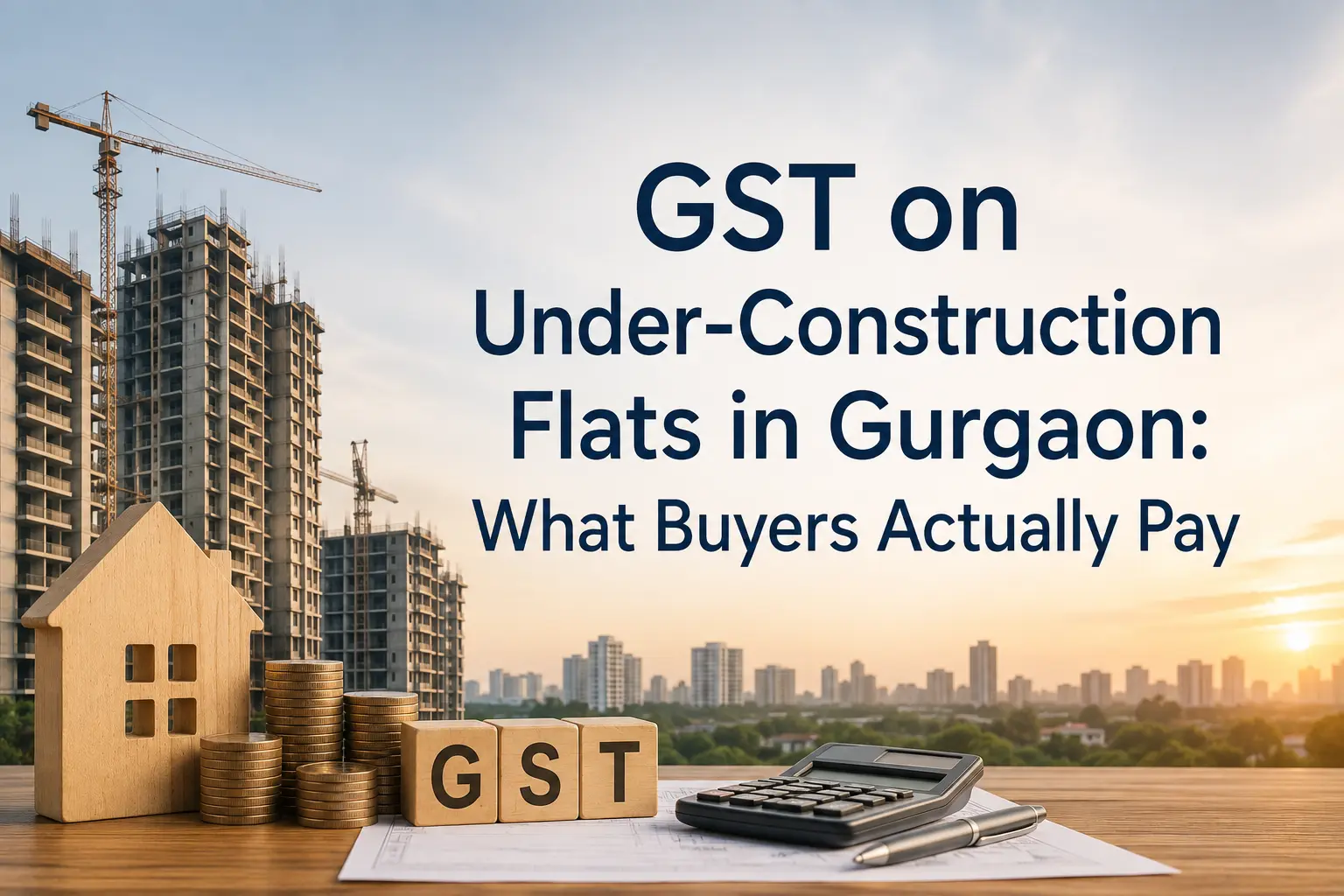
A posh flat in Gurgaon which is still under construction is being sold to a buyer for 4 crore. There may be other costs linked with the transaction, hence the ultimate cost of purchasing may be higher. The property and agreement may include GST, stamp tax, registration costs, Preferential Location Charges (PLC), club or amenity fees, maintenance deposits, parking fees and other associated expenditures.
It is important to understand GST on under construction property before comparing flat rates or making a purchase plan. The GST treatment could be affected by a number of factors such as the state of the property, usage, applicable rate category and whether or not the requisite completion or occupancy certificate has been issued. In this blog, we will talk about the major charges that the purchasers in Gurgaon have to keep in mind while calculating the real cost of buying an apartment which is still under construction.
Is GST Applicable on Under-Construction Property?
When a buyer buys an under-construction property from a developer and the transaction is covered by the GST framework for construction services, GST is typically applicable. In these situations, the buyer is essentially paying for both the real estate transaction and a construction service.
This is not the same as buying a finished home where the necessary completion or occupancy certificate has already been given and, depending on the particular circumstances and applicable regulations, the transaction is exempt from the GST levy on construction services.
Therefore, the property’s status at the pertinent stage of the deal is important to Gurgaon buyers. Instead of presuming GST applies just because the flat is being sold by a developer, buyers should examine the agreement, payment schedule, and completion/occupancy status.
What Is the GST Rate on Under-Construction Residential Property?
For properties outside of the affordable-housing category under the existing residential real estate framework, the GST on an eligible under-construction residential flat is typically 5%, with no Input Tax Credit (ITC) under the relevant scheme. If the specified affordable-housing requirements are met, qualifying affordable residential flats typically receive an effective 1% GST, also without ITC.
Because Gurgaon is expressly included in the Delhi NCR metropolitan area for the GST affordable-housing definition, the distinction is important to Gurgaon buyers. However, a property must meet the relevant carpet-area and value requirements in order to be eligible; an apartment’s location by itself does not make it affordable.
Subject to the project’s particular tax status and the regulations in effect at the time of purchase, the majority of premium and luxury apartments that Shray Projects discusses will typically fall into the ordinary residential category, making the appropriate GST rate 5%.
Is GST Applicable on Luxury Apartments in Gurgaon?
Yes, when a luxury flat in Gurgaon meets the requirements of the relevant GST regulations as a taxable supply of an under-construction residential property, GST may be applied. But because the property costs 5 crore, 10 crore, or 20 crore, there isn’t a distinct ‘luxury apartment GST rate’. Based on the property’s categorisation and the terms of the sale, the rate is determined under the relevant residential GST system.
Subject to the regulations in effect at the time of purchase, the applicable rate for a typical residential unit covered by the post-2019 plan is typically 5% without Input Tax Credit. If all requirements are satisfied, qualifying affordable housing may instead be subject to the relevant 1% rate.
This applies to all Gurgaon luxury corridors where high-end residential complexes are prevalent, including Golf Course Road, Golf Course Extension Road, Dwarka Motorway, Southern Peripheral Road (SPR) and New Gurgaon. The GST rate of the property is not solely determined by its price.
Is GST Applicable on Ready-to-Move Flats?
A completed or ready-to-move home is subject to a different GST classification than an apartment that is still under construction. When payment is received prior to the relevant completion certificate or first-occupation milestone, as applicable, a construction service may be taxable under GST rules. A qualifying sale of finished real estate is often exempt from the GST duty on construction services after the applicable legal requirement is met.
As a result, purchasers shouldn’t assume that all properties advertised as ready-to-move have zero GST. Both the project’s legal status and the date of consideration are crucial. Buyers should confirm whether the relevant completion certificate has been given, whether first occupation has taken place, and when consideration was received, even if a developer claims a unit is ready for possession. Buyers should examine the agreement, payment plan, and completion papers to determine the proper GST treatment.
Occupancy Certificate vs Completion Certificate – Why Buyers Should Care
Completion Certificate (CC): It is a certificate issued for the completion of a building or development constructed as per authorised designs and relevant rules. The completion of a building is often certified by an occupation Certificate (OC), which recognises the building as acceptable or approved for occupation within the applicable local framework, subject to the authority’s criteria.
These documents are important because the GST treatment of a property transaction may be impacted by the property’s completion or occupation status. The appropriate completion certificate or first-occupation requirement is tied to the construction-service exemption under GST law for a sale of completed property. As a result, purchasers shouldn’t depend just on a developer’s description.
How Is GST Calculated on an Under-Construction Flat?
Take the example of a 3 crore flat in Gurgaon with a 5% applicable GST rate. A straightforward computation would be:
₹3 crore × 5% = ₹15 lakh GST
But this is merely a simple example. The nature of the supply, the developer’s agreement, the demand structure, and the applicable GST valuation regulations must all be taken into consideration when determining the actual taxable value and GST amount. It is not advisable for buyers to assume that the total advertised property price is always the taxable value or to immediately apply deductions.
Specifically, the frequently used one-third land deduction should not be applied automatically without first verifying the GST valuation provisions and the unique facts of the transaction that applied at the time of purchase. The GST fee should be evident in the developer’s tax invoice and payment schedule.
Example: What Does a Gurgaon Buyer Actually Pay?
Imagine a luxurious flat in Gurgaon for 4 crore. The advertised price may not reflect the buyer's total purchasing cost. Additional costs may include GST, stamp duty, registration fees, Preferential Location Charges (PLC), club or amenity fees, maintenance or security deposits, parking fees and other developer levies, depending on the way the property is structured and the agreement between the parties. Interiors, furniture and fit-outs may be subject to additional fees for the buyer after possession.
Each charge’s precise amount may change depending on the project, the type of property, the conditions of the agreement, and the buyer’s circumstances. Presenting a single, fixed final price for each 4 crore flat would therefore be deceptive.
The main lesson is simple:
Total Acquisition Cost ≠ Advertised Price
Is GST Included in the Builder’s Quoted Price?
Depending on how the developer has organised and presented the offer, a builder’s quoted price may or may not include GST. One deal can be marketed as an all-inclusive price, while another might be advertised as ₹X crore + applicable taxes and charges. Customers should never assume that all expenses are included in the headline amount.
Before booking an apartment that is still under construction, ask the developer for a detailed cost sheet. Make sure you see the base purchase price, GST applicable, Preferential Location Charges (PLC), club or amenity fees, parking related costs, maintenance or security deposits, other development fees and any government taxes.
Additionally, the buyer should enquire as to whether the reported figures are inclusive or exclusive of tax and whether sums are subject to GST. It can be deceptive to compare Gurgaon properties only based on the headline price. The entire all-inclusive acquisition cost payable under the agreement is a more useful comparison.
GST on PLC, Club Membership and Other Builder Charges
The GST treatment of additional builder charges is contingent upon the type of charge, the agreement’s structure, and whether or not it is a component of a composite construction supply. For instance, the GST Council has made it clear that Preferential Location Charges (PLC) can be included in the composite construction supply and be subject to the same tax treatment provided they are collected with construction consideration prior to the appropriate completion certificate.
It is not always the case that other sums, like club or amenity fees, maintenance-related collections, and distinct developer services, will be subject to the same GST treatment. Depending on the particular service and the terms of the contract, they may be taxable.
Buyers in Gurgaon should thus ask for a comprehensive cost sheet that details each fee individually, together with its GST treatment and the relevant rate. Instead of applying a single GST rate to all builder charges, the author should check the current treatment of each key fee against the most recent GST notifications and clarifications prior to publication.
Is GST Applicable to Parking?
Because the tax treatment of parking fees might vary depending on the parking structure, the buyer’s rights, and whether the fee is a distinct service or part of the overall construction supply, the GST treatment of parking fees should not be presented as a universal rule. For instance, instead of automatically treating a separate right to use a parking space as part of the construction service, a GST authority has treated it as an independent supply in a specific instance.
Depending on the project and the type of parking layout, parking may also be treated differently under the law and regulations. As a result, purchasers shouldn’t assume that each parking fee will be subject to the same GST as the unit.
The practical solution is straightforward: request a comprehensive cost sheet from the developer that details the GST treatment of each component, including the cost of the apartment, parking, PLC, club fees and other expenses. Before paying, buyers should confirm the applicable treatment.
Can Homebuyers Claim Input Tax Credit?
Homebuyers should make a distinction between the Input Tax Credit (ITC) offered under the developer’s GST framework and the GST they pay to the developer. The usually applicable 5% rate for standard residential flats and the 1% rate for eligible affordable housing are structured without ITC under the current residential real estate plan.
This implies that a developer is typically not allowed to claim ITC under the specified scheme and transfer that benefit to the buyer in the form of a lower GST payment. In a similar vein, a regular person purchasing a home for their own residential usage shouldn’t believe that the GST they paid can be reimbursed as an ITC. ITC is subject to statutory requirements and is essentially intended for qualified taxable business activities.
GST vs Stamp Duty – Are They the Same?
No stamp duty , GST and registration fees are additional costs that come up when you buy or sell a property . Paying GST on a flat which is still under construction does not waive the stamp duty and registration expenses. These costs may have to be budgeted for separately as they fall under a variety of legal regimes.
For a buyer from Gurgaon, the total transaction cost may include GST, Haryana stamp duty, registration fees and other developer or project-specific expenditures. Buyers should ask for a full cost sheet before they reserve so they know how much is going to taxes, government fees and developer fees. Thus, the comparison of properties just on the base price given may lead to a false impression about the amount of money required to complete the transaction.
GST on Resale Property
The acquisition of construction services from the developer is fundamentally different from the classic selling of a ready-made residential property from the previous owner. Generally, GST is not imposed only because an existing home is being resold, so long as the transaction is within the applicable completed-property regime.
But the fact that there is no GST doesn’t mean there are no other costs involved in the transaction. A Gurgaon buyer may have to factor in stamp duty, registration fees, TDS, broking, legal verification and other transaction charges. The buyer should also verify the title of the property, any dues, debts and approvals before finalising the acquisition.
Purchasing an under-construction taxable construction supply from a developer and purchasing a finished immovable property in a traditional resale transaction are the two main differences. Before presuming that GST applies or does not, buyers should confirm the property’s completion or occupation status as well as the precise transaction structure.
GST on Assignment/Transfer Before Possession
In Gurgaon, investors sometimes book an apartment under-construction, and then opt to assign/transfer the reservation to someone else before possession. These transactions could have more intricate GST, contractual and tax implications than a straightforward property acquisition. The type of assignment, the contractual arrangement, the stage of the building and the way the developer deals with the transfer can all make a difference to the correct course of action.
The buyer should check the builder’s transfer or assignment policy, the terms of the original agreement, the appropriate GST treatment, any capital gains implication, and TDS liabilities before proceeding forward. The buyer should also make sure if there are any development fees, administrative expenditures or transfer fees.
There isn’t a single GST response that works for all pre-possession assignments. Before completing the assignment or getting paid, the parties should have expert tax and legal counsel because the transaction may involve both the original property agreement and a separate transfer arrangement.
GST on Commercial Property vs Residential Property
Buyers shouldn’t apply the residential 5% GST framework to all properties that are still under development. Depending on the kind of supply, project structure, and relevant regulations, commercial real estate such as an office building, retail store, SCO (Shop-cum-Office), or other commercial unit may be subject to a varied GST classification.
Under the post-2019 arrangement, the 5% rate often associated with ordinary residential construction is specific to qualifying residential real-estate transactions and should not be applied universally to commercial property.
This is an important distinction for Gurgaon investors, as many of the buildings combine residential and commercial offers. Buyers should check the applicability of GST on the said transaction as per the existing GST regime and ask the developer for the appropriate GST rate, taxable value and full cost sheet before booking a commercial property.
Does GST Apply to Under-Construction Builder Floors?
The type and structure of the transaction determine the GST treatment for a builder floor that is still under development. GST may be imposed under the relevant conditions if the agreement calls for the provision of a taxable construction service prior to the relevant completion or occupation milestone. Buyers shouldn’t, however, anticipate that every builder-floor sale will have the same GST treatment as an apartment bought from a major developer.
The tax analysis may be impacted by the agreement’s inclusion of land rights, building duties, development agreements, or several parties. Therefore, buyers should carefully review the construction and sale agreements, the payment schedule, and the state of completion.
Buyers are advised to obtain independent legal and tax advice before signing the contract or making substantial payments for builder floors in Delhi NCR, especially in situations where there are pledges of property rights and construction.
When Is GST Paid?
GST is payable normally along with the payment demands of the developer for an eligible under construction project, as per the project agreement and payment or construction schedule. The date and quantum would be subject to the payment terms stipulated in the contract and the GST provisions applicable to the transaction. Buyers need to read each developer demand notice carefully to understand the amount being taxed, GST rate and GST amount being charged.
All the essential GST invoices and payment receipts, developer’s demand letters and tax related information should be kept by the buyers for future verification and record keeping. These documents may be used to reconcile the amounts paid under the agreement with the final statement of account .
Can GST Change During Construction?
The Builder-Buyer Agreement (BBA) is a crucial document for comprehending the buyer’s potential liabilities because GST rates and tax regulations might change over the course of a multi-year construction project. Clauses pertaining to GST, taxes, government levies, legislative changes, and additional statutory costs should be carefully read by buyers.
The agreement may outline how statutory liability will be increased, decreased, or changed, as well as whether the developer is entitled to further compensation from the buyer. The precise wording is important, especially if construction takes several years to complete.
Therefore, buyers should refrain from thinking that the GST treatment that was in effect on the booking date will necessarily stay the same throughout the project. They should be aware of who is responsible for any changes in statutory liability and how additional demands will be computed before they sign.
How to Calculate the Total Cost of an Under-Construction Property?
Property Cost
- Applicable GST
- Stamp Duty
- Registration Charges
- Applicable PLC
- Club/Amenity Charges
- Maintenance/Security Deposits
- Other Developer Charges
- Loan Costs
- Interior/Furnishing Budget
- = Approximate Total Acquisition Cost
Under-Construction vs Ready-to-Move: GST Perspective
| Under Construction | Qualifying Completed/Ready Property | |
| GST on property transaction | Generally applicable if transaction is a taxable construction supply | Generally not applicable to a qualifying completed-property sale |
| Physical inspection | Limited during construction | Generally possible |
| Immediate possession | No | Yes, subject to actual possession status |
| Construction risk | Present | Generally lower |
| Payment schedule | Often staggered according to the agreement | Usually more immediate |
| Rental income | Generally begins after possession | Can potentially begin sooner |
Common GST Mistakes Gurgaon Buyers Make
Buyers in Gurgaon may underestimate the cost of their home by making basic assumptions about GST. Without consulting the developer’s cost sheet, it is a common error to assume that the advertised price already includes GST. Additionally, even though stamp duty and registration fees are distinct expenses, buyers can mistake them for GST. Assuming that a property advertised as “ready-to-move” inherently has no GST without verifying its actual completion or first-occupation status is another error.
Additionally, just because a luxury flat is residential does not mean that buyers should apply the 1% affordable-housing rate to it. Another frequent mistake is to assume that individual homebuyers are eligible for ITC. In addition to requesting a thorough cost sheet and comparing projects using the all-inclusive purchase cost, buyers should budget for registration, loan expenses, and interiors. They should also verify GST treatment for any applicable PLC, club, parking, or other developer charges.
Questions to Ask the Developer Before Booking
- Is the quoted property price inclusive or exclusive of GST?
- What GST rate is being charged, and why does it apply to this property?
- What is the project’s current construction and completion status?
- Has the relevant Completion Certificate (CC) or Occupancy Certificate (OC) been obtained, where applicable?
- Which additional developer charges attract GST?
- What is the applicable Preferential Location Charge (PLC)?
- Are club, amenity or membership charges included in the quoted price?
- What maintenance, corpus or security deposits are payable?
- What stamp duty and registration charges should the buyer budget for?
- Can the developer provide a complete, itemised, all-inclusive cost sheet before booking?
Conclusion
Budgeting for a Gurgaon flat requires an understanding of GST on under-construction property, yet GST is only a portion of the total cost. Instead of evaluating houses solely based on their basic sale price or price per square foot, buyers should consider the entire purchase cost.
For instance, after accounting for applicable GST, stamp duty, registration costs, developer fees, maintenance deposits, and interiors, a 4 crore flat may need a significantly greater budget. Shray Projects can assist purchasers in comparing project prices and comprehending the overall cost of purchasing houses in Gurgaon. Before completing the transaction, buyers should confirm precise tax positions with a certified CA or tax professional because GST application, tax treatment, and individual circumstances can differ.
FAQs